Waiting until the mid-pregnancy ultrasound isn’t the only way to learn a baby’s sex. An early gender blood test can look for small amounts of fetal DNA circulating in the pregnant person’s bloodstream, potentially providing information much earlier. However, not every blood test works the same way, and timing, testing method, laboratory procedures, and the reason for testing all matter. Medical prenatal screening such as noninvasive prenatal testing (NIPT) also serves a very different purpose from a commercial test marketed mainly for early sex prediction.
For parents considering early testing, the useful questions go beyond “boy or girl?” It’s worth understanding what the test actually measures, how early it can reasonably be performed, what an unexpected result might mean, and whether the test provides any medical information.
What Is an Early Gender Blood Test?
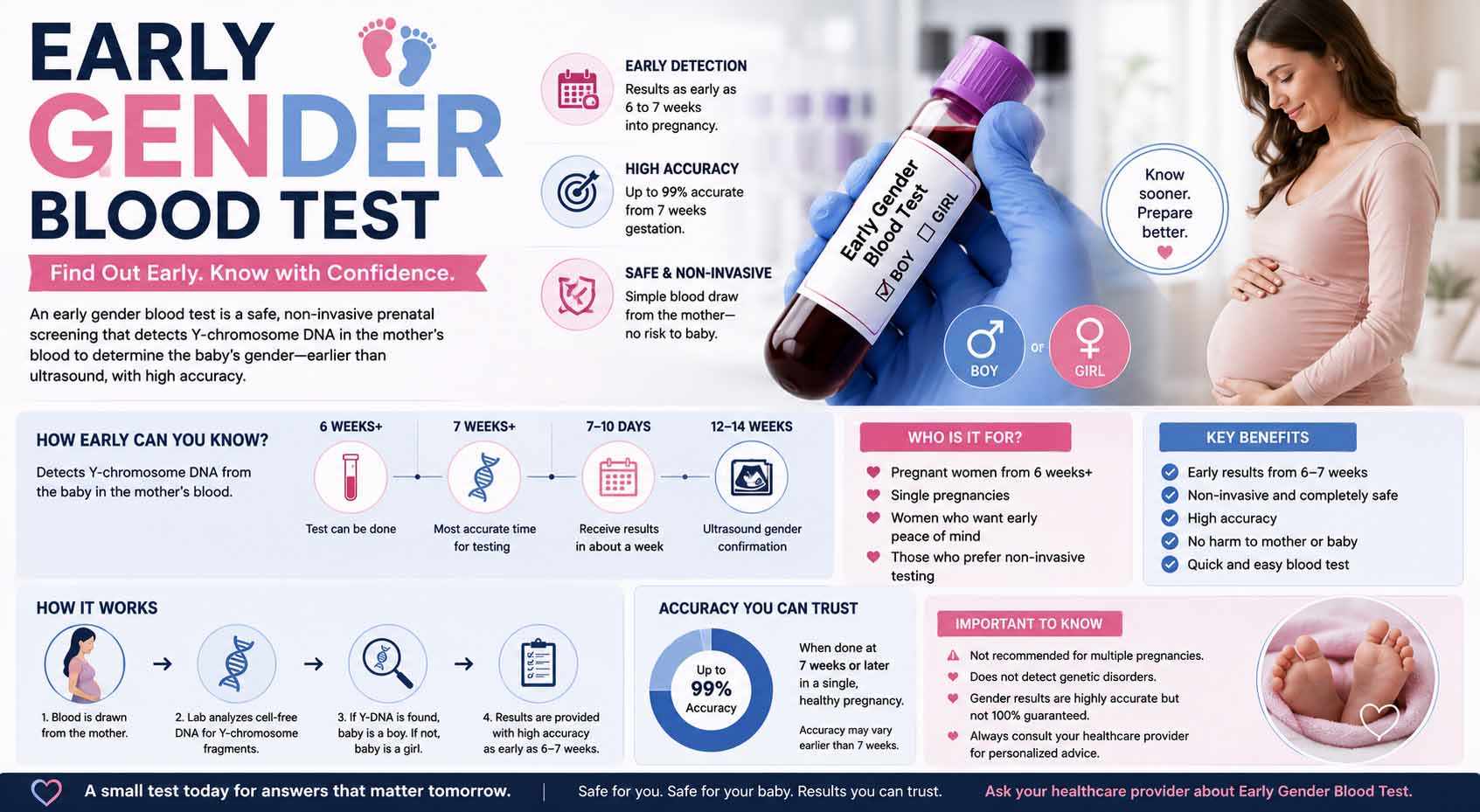
During pregnancy, small fragments of DNA from the placenta circulate in the pregnant person’s blood. This material is commonly called cell-free fetal DNA, or cfDNA, although much of the pregnancy-related cfDNA detected in maternal blood comes from the placenta.
A blood test can analyze these fragments. When Y-chromosome material is detected, the result generally indicates a male fetus. When it isn’t detected, the result may indicate a female fetus, depending on the test method and whether enough fetal or placental DNA was present in the sample.
This is different from a routine pregnancy test. Pregnancy tests detect human chorionic gonadotropin, or hCG, rather than analyzing chromosomes.
Therefore, someone wondering when is the best time to take a pregnancy test morning or night is dealing with a different type of testing question. A home pregnancy test establishes whether pregnancy is likely; a fetal-sex blood test requires an established pregnancy and analyzes different biological markers.
How Early Can a Blood Test Detect Gender?
So, how early can a blood test detect gender? The answer depends on the specific test.
Clinical cell-free DNA screening, often called NIPT or NIPS, can generally be performed from around 10 weeks of pregnancy. According to the American College of Obstetricians and Gynecologists (ACOG), cell-free DNA screening can begin at 10 weeks and screens for certain chromosomal conditions. Depending on the laboratory and test, information about fetal sex may also be reported.
Some commercial tests marketed specifically for fetal-sex prediction claim that testing can be performed earlier than standard NIPT. However, their timing requirements, validation, collection methods, and accuracy claims vary.
Therefore, parents shouldn’t assume that every early blood test has the same evidence base or clinical purpose.
If you’re using a commercial service, check its minimum gestational-age requirement carefully. Meanwhile, if you’re considering NIPT, discuss the appropriate timing and purpose of the screening with your prenatal healthcare professional.
Early Blood Test for Gender vs NIPT
Although both approaches may involve a maternal blood sample, an early blood test for gender and NIPT aren’t necessarily equivalent.
NIPT is a prenatal screening test. Its primary medical purpose is to estimate the chance of certain chromosomal abnormalities, rather than simply reveal fetal sex.
Depending on the screening panel, NIPT may assess the likelihood of conditions involving chromosomes 21, 18, and 13. Some tests also assess sex chromosomes. However, screening results aren’t diagnostic, so a high-risk result may require diagnostic testing such as chorionic villus sampling (CVS) or amniocentesis.
A commercial fetal-sex test, in contrast, may be designed mainly to detect the presence or absence of Y-chromosome DNA.
Here’s a simple comparison:
| Feature | Clinical NIPT | Commercial Early Sex Test |
|---|---|---|
| Main purpose | Prenatal chromosome screening | Predicting fetal sex |
| Typical timing | Often from about 10 weeks | Varies by product |
| Blood sample | Maternal blood | Maternal blood |
| Fetal sex information | Often available | Primary result |
| Screens for chromosome conditions | Yes, depending on panel | Usually no |
| Diagnostic test | No | No |
| Medical supervision | Usually ordered through healthcare care | May be direct-to-consumer |
Because products and laboratory policies change, always check the current information for the exact test you’re considering.
How Does the Test Work?
The process for a clinical blood test is usually straightforward. A healthcare professional draws blood from a vein, and the sample goes to a laboratory for analysis.
The laboratory separates plasma from the blood cells and analyzes cell-free DNA fragments. Then, depending on the test, laboratory methods look for chromosome-related signals.
Commercial tests may use a professional blood draw or an at-home collection system. Consequently, the collection process differs considerably among providers.
The amount of pregnancy-related cfDNA in the sample also matters. Laboratories often refer to the proportion as the “fetal fraction.” If there isn’t enough suitable DNA, the laboratory may be unable to produce a reliable result.
How Early Can You Do a Blood Test for Gender Accurately?
Parents often ask how early can you do a blood test for gender because they want the earliest possible answer. However, earlier isn’t automatically better.
Pregnancy-related cfDNA generally becomes more useful for clinical screening as pregnancy progresses. Therefore, performing a test before its validated testing window can increase the chance of an inconclusive or unreliable result.
For NIPT, following the laboratory’s gestational-age requirements is especially relevant. A healthcare professional calculates pregnancy dating using information such as the last menstrual period, ultrasound findings, and fertility-treatment dates when applicable.
Before pregnancy begins, timing questions are different. For example, the best time to take ovulation test relates to detecting the LH surge when trying to identify the fertile window, rather than estimating fetal sex after conception.
In other words, ovulation testing, pregnancy testing, and fetal DNA testing occur at separate stages and answer separate questions.
How Accurate Are Early Gender Blood Tests?
Accuracy depends on which test you’re discussing.
Clinical cfDNA screening can identify fetal sex with high accuracy when the test is performed at the appropriate gestational age and returns an interpretable result. Still, no screening method should be described as infallible.
Commercial early fetal-sex tests may also report high accuracy figures. However, consumers should look beyond the percentage printed on the packaging. Check whether the accuracy comes from peer-reviewed research, independent validation, or company-generated data, and make sure the study population matches how the test is currently used.
Several factors may complicate results, including:
- Testing too early
- Insufficient fetal fraction
- Laboratory or sample problems
- Vanishing twin situations
- Certain maternal chromosome differences
- Placental biological differences
- Multiple pregnancy
- Rare medical circumstances
For an at-home test, collection procedures may introduce other concerns depending on the technology. Therefore, carefully follow the manufacturer’s instructions.
What If the Blood Test and Ultrasound Disagree?
Sometimes a blood-test result and a later ultrasound appear inconsistent.
First, don’t assume either result automatically proves that something is wrong. Pregnancy dating, fetal position during ultrasound, laboratory factors, biological variation, and other circumstances may contribute to an unexpected result.
Instead, discuss the discrepancy with an obstetric healthcare professional.
Your clinician can review which blood test was performed, when it was taken, whether it was a clinical screening test or consumer product, and what the ultrasound actually showed.
Depending on the situation, further evaluation may be recommended. However, parents shouldn’t try to diagnose the reason for a mismatch using online information alone.
Early Gender Testing in Twin Pregnancies
Twin and higher-order pregnancies require extra caution when interpreting fetal-sex information.
If Y-chromosome material appears in a twin pregnancy, it may indicate that at least one fetus is male. However, a basic result may not necessarily identify the sex of each individual fetus.
Test capabilities vary. Therefore, parents expecting multiples should ask the laboratory or prenatal clinician exactly what information the selected test can provide.
A vanished twin may also complicate some cfDNA results because DNA from a pregnancy that stopped developing can remain detectable for a period.
For that reason, pregnancy history and ultrasound findings can matter when interpreting prenatal screening.
Is an Early Gender Blood Test Safe?
A standard maternal blood draw is considered minimally invasive because testing uses blood from the pregnant person rather than placing a needle into the uterus.
That distinction is one reason cfDNA screening is described as noninvasive.
However, “noninvasive” shouldn’t be confused with “diagnostic.” NIPT estimates risk for specific chromosomal conditions; it does not definitively diagnose those conditions.
Diagnostic procedures such as CVS and amniocentesis directly analyze fetal or placental genetic material and have different purposes, timing, benefits, and risks. Therefore, healthcare professionals may recommend genetic counseling or diagnostic testing after certain screening results.
Blood Tests Don’t Predict Pregnancy Symptoms
Learning fetal sex early can be exciting, but pregnancy symptoms aren’t reliable methods of predicting whether you’re carrying a boy or girl.
Nausea, cravings, skin changes, fetal heart rate, belly shape, and similar traditional predictions can’t reliably determine fetal sex.
Morning sickness is a good example. Parents may hear claims that its severity reveals the baby’s sex, yet symptoms vary widely among pregnancies and aren’t a substitute for genetic testing or ultrasound.
Instead, someone asking when does morning sickness end should treat nausea as a pregnancy-health question rather than a fetal-sex prediction method. Persistent or severe vomiting also deserves medical attention, especially when keeping down fluids becomes difficult.
NIPT Is Screening, Not a Diagnosis
One of the most common misunderstandings around prenatal blood testing involves the word “accuracy.”
NIPT performs very well as a screening method for certain chromosomal conditions, but a screening result describes probability rather than providing a definitive diagnosis.
For example, a positive screening result for a chromosomal condition usually requires discussion with a healthcare professional and may be followed by diagnostic testing.
Likewise, an apparently low-risk result doesn’t guarantee that a fetus has no genetic or developmental condition.
Therefore, parents should understand the entire report rather than focusing only on the fetal-sex line.
When Hormone Testing Is Different
Pregnancy involves substantial hormonal changes, so blood tests may be ordered for many reasons unrelated to fetal sex.
Depending on the clinical situation, a healthcare professional may measure hCG, thyroid hormones, progesterone, or other markers. However, these tests don’t work like cfDNA analysis.
Likewise, when is the best time to test for hormone imbalance depends on which hormone is being investigated, a person’s symptoms, menstrual cycle, pregnancy status, medications, and the clinician’s reason for testing.
Therefore, don’t interpret a hormone blood test as an alternative way to determine fetal sex.
Common Myths About Finding Out Baby’s Sex Early
A high fetal heart rate means it’s a girl
Fetal heart rate isn’t a dependable method of predicting fetal sex. Heart rate changes throughout pregnancy and can vary for many normal reasons.
Strong morning sickness means it’s definitely a girl
Some research has explored associations between pregnancy symptoms and fetal sex, but symptoms cannot reliably determine an individual baby’s sex.
Blood testing is always 100% accurate
No test should be treated as universally perfect. Accuracy depends on the method, gestational timing, sample quality, biological factors, and whether the laboratory obtains a reportable result.
Any blood test during pregnancy can reveal fetal sex
Routine prenatal bloodwork does not automatically analyze fetal DNA. The test must specifically include the relevant genetic analysis.
FAQs About Early Gender Blood Tests
What week can a blood test tell the baby’s gender?
Clinical cfDNA screening such as NIPT is generally available from around 10 weeks of pregnancy. Some commercial fetal-sex tests advertise earlier testing, but minimum timing and supporting evidence vary by product.
Is a Blood Test More Accurate Than an Ultrasound ?
Both methods can provide fetal-sex information when performed appropriately, but they work differently. CfDNA analyzes genetic material in maternal blood, while ultrasound identifies visible fetal anatomy. Ultrasound accuracy also depends on gestational age, fetal position, equipment, and the examiner.
Can NIPT tell me whether I’m having a boy or girl?
Many NIPT panels can report fetal sex based on sex-chromosome information. However, available reporting varies by laboratory, location, pregnancy type, and test panel.
Can an early blood test be wrong?
Yes. Although validated tests can be highly accurate, incorrect or inconclusive results are possible. Testing timing, low fetal fraction, multiple pregnancies, biological factors, and laboratory issues can affect interpretation.
Do I need an early gender blood test?
No. Finding out fetal sex early is optional unless genetic information is being evaluated for a specific medical reason. Some parents prefer to wait for ultrasound, while others choose not to learn fetal sex before birth.
Should I choose a commercial test or NIPT?
Choose based on your goal. If you only want early fetal-sex information, a consumer test may offer that service. However, if you’re considering prenatal chromosome screening, talk with your obstetric clinician about NIPT and what its results can and cannot tell you.
What to Know Before You Test
An early gender blood test can provide fetal-sex information well before the traditional mid-pregnancy anatomy ultrasound, particularly when cfDNA technology is used at an appropriate stage of pregnancy. However, the test’s purpose matters just as much as its timing.
If you’re considering NIPT, discuss its screening benefits, limitations, timing, and possible follow-up results with your prenatal healthcare professional. Meanwhile, if you’re considering a commercial test mainly for curiosity, check its validated testing window, collection method, evidence behind its accuracy claims, and policy for inconclusive results.
Most of all, keep fetal-sex prediction separate from prenatal diagnosis. Learning whether you’re likely expecting a boy or girl can be an exciting milestone, while medical screening decisions deserve their own careful discussion with a qualified healthcare professional.